Update on our Housing Service performance
Listening to residents, acting quickly and learning from past failings are at the heart of the programme, and we are pleased to report significant progress.
Complaints performance
Improving the quality and responsiveness of our complaint handling has been a top priority. This follows a period of regular engagement with the Housing Ombudsman after a special investigation first announced in July 2024. We have been providing monthly updates to the Ombudsman and they are now satisfied that we have followed up on the recommendations of their report.
We have transformed our complaints process. Stage 1 response times improved significantly through 2025, with December performance increasing to 86 per cent responded to on time – the seventh month out of eight where performance was at or above 80 per cent. This improvement follows new training, better monitoring and the appointment of a Housing Complaints Transformation Lead.

The number of cases escalated to the Housing Ombudsman has also fallen sharply. In the final quarter of 2025, only 1% of Stage 2 cases were escalated – a major reduction compared with earlier periods.
Tackling hazards and improving safety
A central focus of our action plan is our drive to eliminate serious housing hazards and fully meet the requirements of Awaab’s Law.
We have made substantial progress. The latest data on actions completed in response to the 2025 stock condition survey indicates that 88% of our homes now meet the Decent Homes standard, up from the 74% identified in the survey. This puts us well on track to meet our target of the London average of 90% by April this year, pressing towards 95% by April 2027. This has been achieved by resolving more than 2,000 hazards, from missing carbon monoxide alarms to complex damp and mould cases.
In response to Awaab’s Law, we introduced a specialist damp and mould team, improved call-handling times, created new assessment processes to identify vulnerable households and invested in digital systems that enable surveyors to book follow-on repairs during home visits. Early performance data shows the council met the 24-hour response requirement for all high-risk cases since the law was introduced on 27 October 2025.
Stronger communication and resident engagement
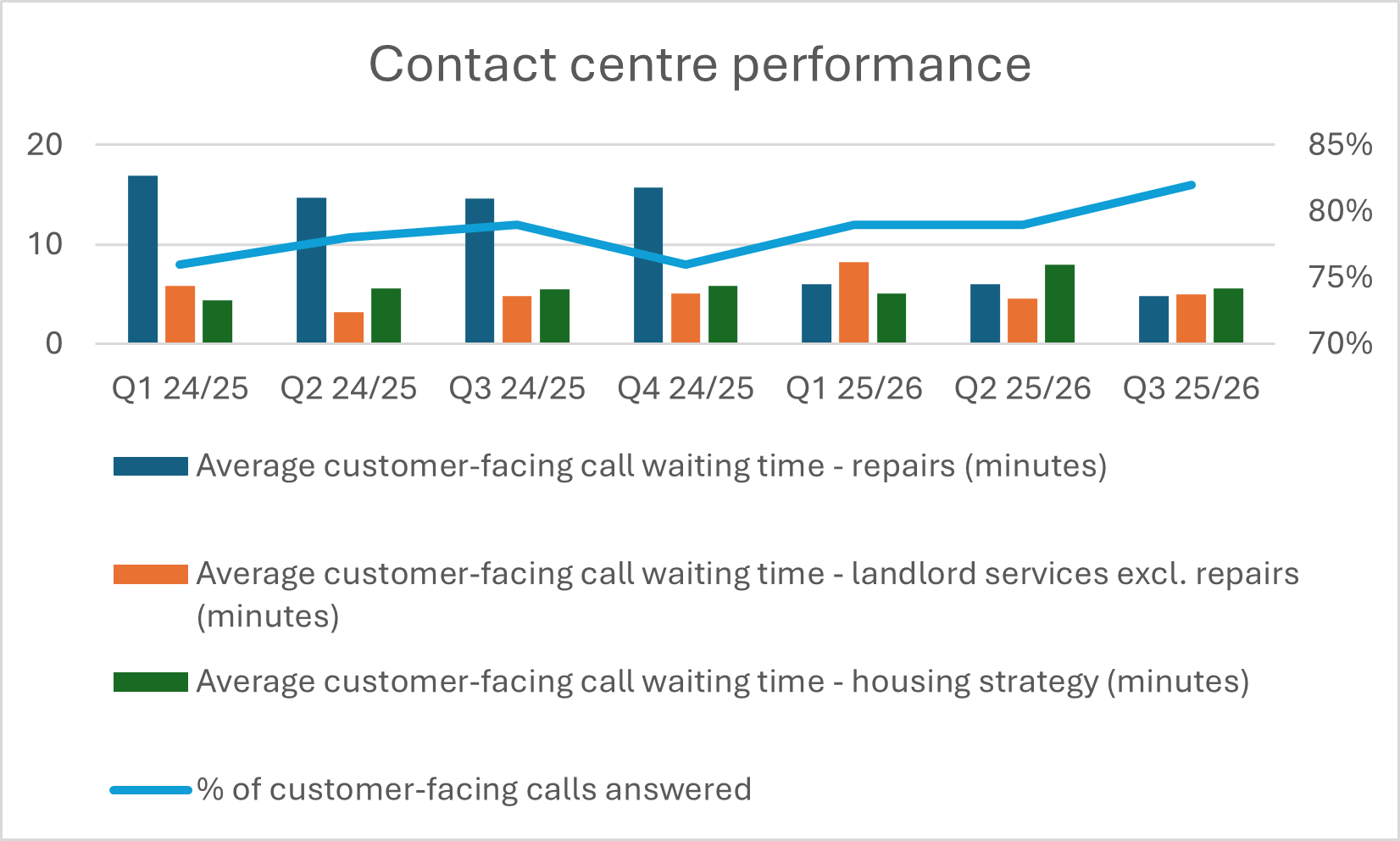
Residents told the Housing Ombudsman Service they often felt ignored, had to chase repeatedly for updates and were frustrated by inconsistent communication. In response, we have developed a communications framework, which sets out clear commitments such as answering calls within 5 minutes, acknowledging correspondence within 2 working days and providing accessible information for tenants with diverse communication needs.
The framework commits to clarity, timeliness and transparency across all housing teams, with staff training programmes to back it up. A new ‘No wrong front door’ approach is being embedded across council services to ensure residents are directed quickly to the right support, regardless of how they first make contact.
We have also commissioned new customer care training for all frontline repairs staff, with modules on managing challenging situations, positive communication and understanding the resident experience.
We will track how well our approach is working via our quarterly customer satisfaction surveys, and adjust accordingly, through a process of continuous improvement.
Improving repairs and contractor management
The action plan also addresses long standing challenges in repairs performance.
We have kept waiting times for our repairs call centre below an average of 6 minutes in the current financial year. This is down from an average of 10 minutes in 2024/25 and 46 minutes in 2023/24.
We have also reduced our repairs backlog to 5,000 from 8,300 in 2024/25 and 14,700 in 2023/24.
One issue repeatedly raised by residents was the impression that we didn’t manage our contractors efficiently and we would lose track of what work had been done.
We have introduced a new contract management structure, and recruited additional contract managers, alongside a digital monitoring system through which all repairs are logged and tracked. This gives us hugely improved oversight of contractor performance and improved recordkeeping.Monthly meetings with contractors are now in place, with some providers already on formal improvement plans.
We are also strengthening our repairs quality assurance processes. Since November, hundreds of resident satisfaction surveys have been collected through the new system, with early data showing the majority of feedback is positive. A dedicated Customer Liaison team will soon manage this data to identify issues early and prevent recurring problems.
Commitment to transparency and long term improvement
We acknowledge there is more to do. But the combination of a strengthened action plan, new digital systems, clearer communication standards and better contractor oversight represents a step change in how the service responds to residents.
Regular reporting to the Council’s Housing Select Committee, ongoing engagement with resident groups and transparent performance monitoring are now embedded to ensure sustained progress and oversight.
The action plan – shaped by resident feedback, Ombudsman findings and new national legislation – is designed to deliver safer homes, faster repairs and better communication.
By strengthening our systems, culture and accountability, we aim to build a more responsive and resident-centred service that delivers the quality and respect tenants rightly expect.
Cllr Will Cooper, cabinet member for Better Homes, Neighbourhoods and Homelessness, says:
"We’re making real progress in putting things right for our tenants. We have reduced the repairs backlog dramatically and improved the proportion of routine and emergency repairs completed on time. Our borough wide housing condition survey is helping us identify and tackle damp and mould faster, supported by new specialist staff.
"Residents are seeing much shorter call waiting times and better handling of complaints. Upgrading our core housing systems is helping us to keep track of repairs and resolve issues more quickly. We know there is more to do, and we remain committed to delivering lasting improvements."